SANITIZED SYSTEM CASE
OpenHealthAtlas
From scattered records to traceable evidence, and from hidden relationships to the next question worth testing.
OpenHealthAtlas prepares comparable evidence by normalizing records into canonical entities with explicit provenance, time, and context—so signals from different systems can be aligned and trusted.
External Hermes then investigates within defined bounds, surfaces patterns and explanations, and formulates the next useful question for people to test, decide, and replay.
- MY ROLE
- PRODUCT DIRECTION / SYSTEMS ARCHITECTURE / IMPLEMENTATION
- Quick tag
- Open the fictional UI demoGitHub
TRANSFERABLE ARCHITECTURE
Why this architecture transfers.
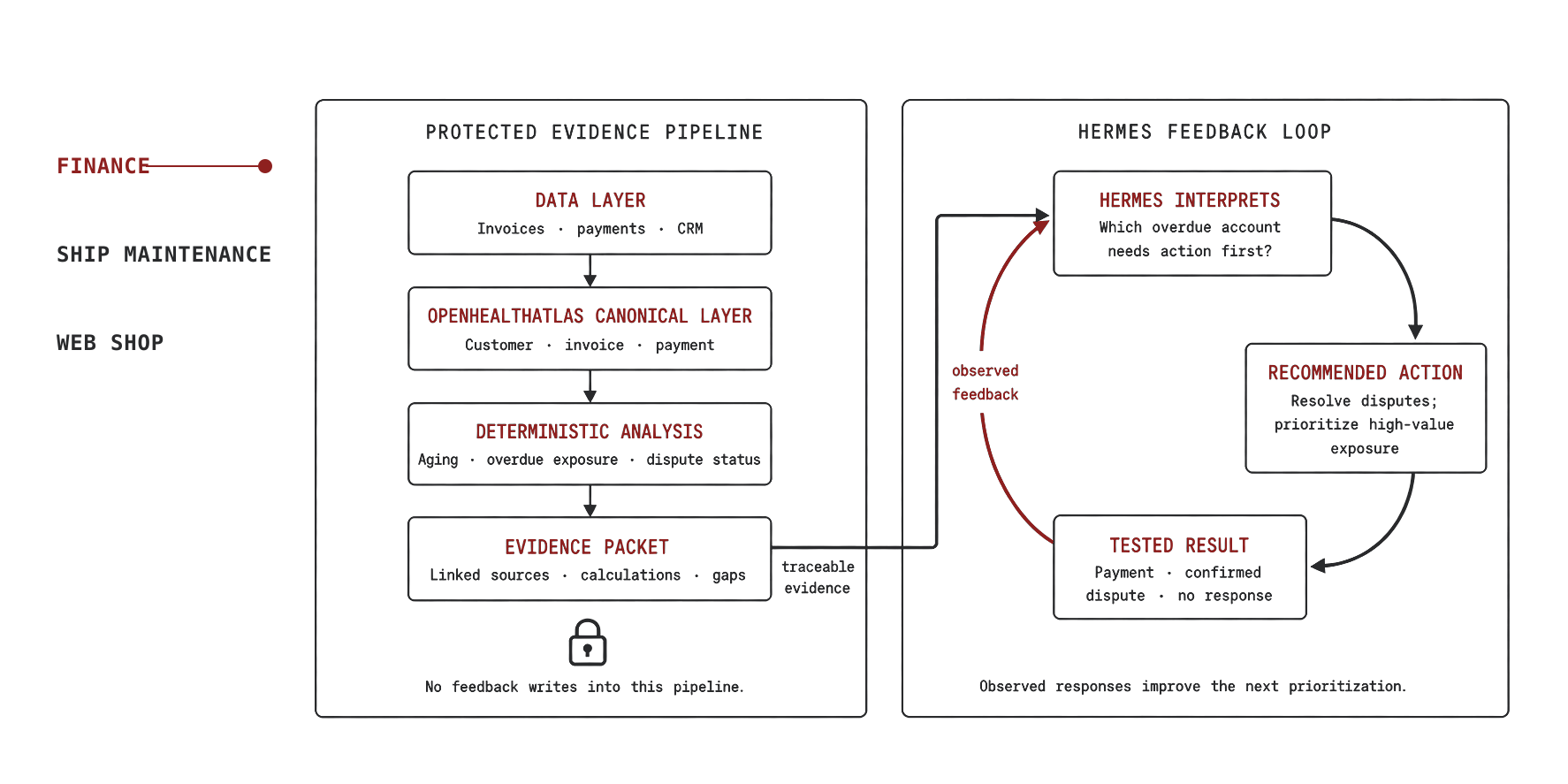
The health example makes the structure visible; the implementation logic applies wherever consequential decisions depend on fragmented records.
Most organizations operate with records spread across systems, inconsistent states, and relationships that are difficult to inspect together. The architecture turns that fragmentation into a repeatable capability: canonical evidence, bounded investigation, human judgment, and a replayable outcome.
Implementation begins by mapping the decision, defining canonical entities and time semantics, and registering deterministic operations. The domain changes. The evidence-first architecture remains.
PROBLEM
The problem was not a lack of AI.
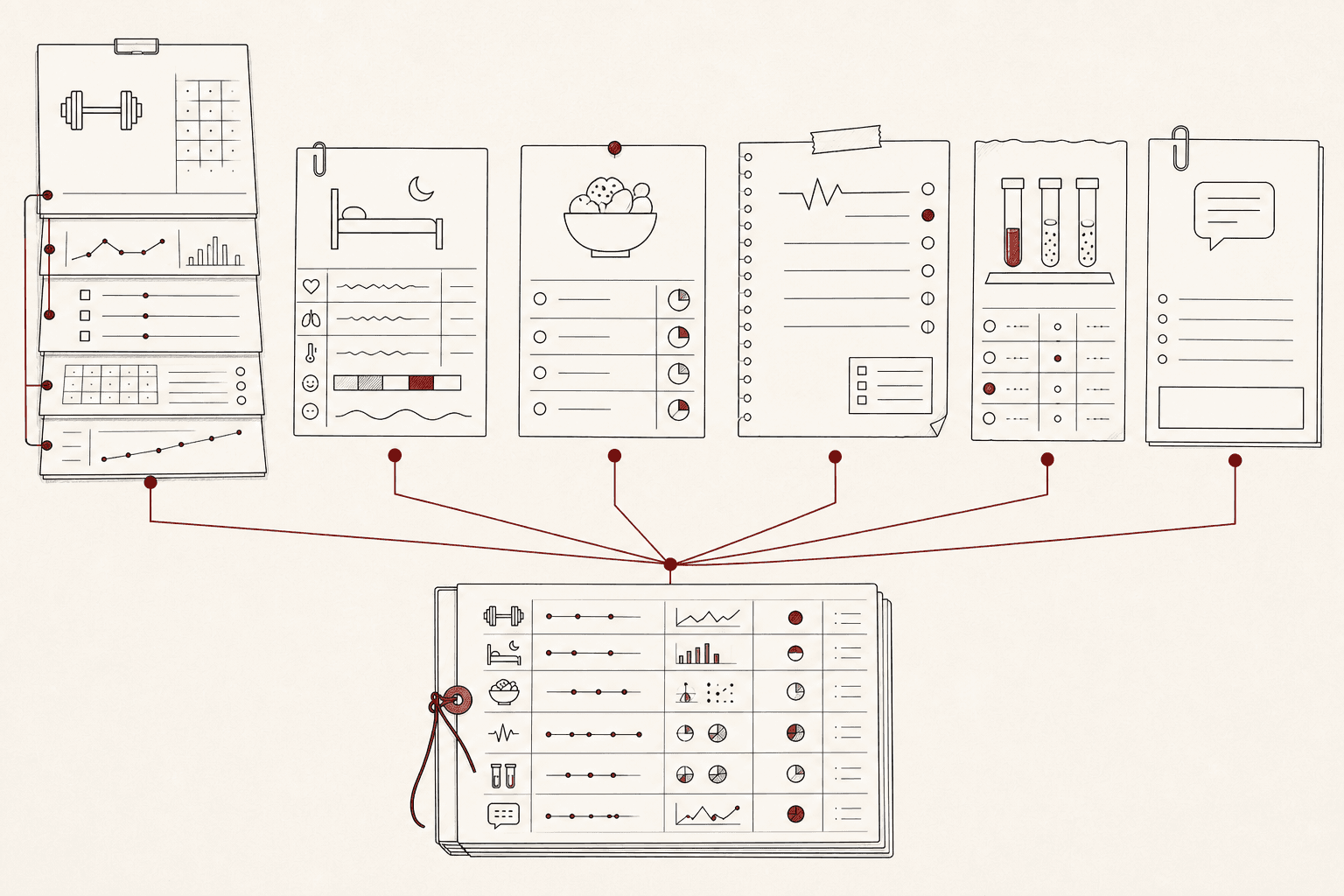
Data existed, but incompatible identities, units, timestamps, and states made dependable comparison difficult.
Training, recovery, nutrition, symptoms, laboratory values, and observations arrived in different shapes. Placing them on one screen would not make them comparable, time-aware, or trustworthy.
The expanded Training record shows the real work hidden beneath a category label: sessions, exercises, load, context, and provenance each need an explicit place before a downstream system can interpret them together.
CANONICAL MODEL
Preserve meaning before calculation.
Every normalized observation keeps its identity, measurement, time, and provenance intact.
I defined a canonical record contract that preserves source identity, units, observation state, and the difference between event time, effective time, and provenance time.
That structure prevents silent conversions and unstated assumptions. If a mapping or definition changes, affected evidence can be traced and rebuilt instead of persisting as an uninspectable summary.
Authored canonical evidence model
Identity
entity_typeentity_idsource_systemexternal_idstateversionMeasurement
kindvalue_numericvalue_textunitmethodnormal_rangeTemporal
observed_atrecorded_ateffective_atperiod_startperiod_endtimezoneProvenance
collected_bydevice_idsource_systemingested_attransformationconfidenceREADINESS AND CALCULATION
Deterministic by design.
Registered methods establish what can be calculated, and failure states explain when the evidence cannot support the request.
OpenHealthAtlas validates the bounded request, checks comparable coverage, runs a registered method, and returns the limitations with the result. The same evidence and method produce the same calculation.
Insufficient data is a useful outcome because it identifies the next evidence gap. Unsupported and refused requests remain explicit instead of degrading into best-effort prose.
Registered method flow
- Validate requestCheck inputs, entities, method, and bounds.
- Check readinessAssess evidence coverage and comparability.
- Calculate registered methodExecute fixed rules on canonical evidence.
- Attach limitationsReturn assumptions, context, and provenance.
okAll requirements met.insufficient_dataRequired evidence or context is missing.unsupportedThe method is not registered in this context.refusedThe request exceeds declared bounds.
IMPLEMENTATION AND PRIVATE ACCESS
How it runs—private by design.
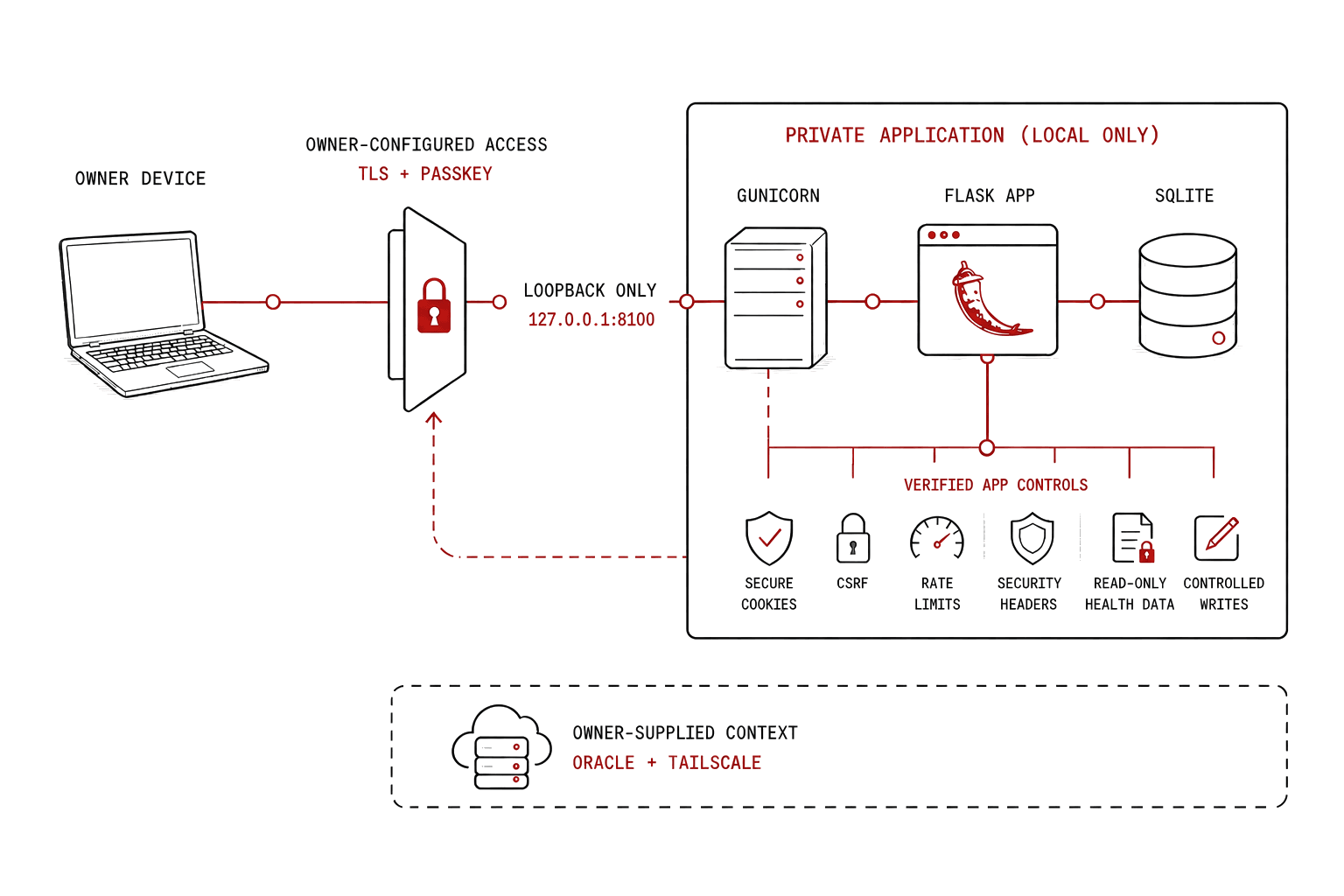
Source verifies the application stack and access controls; hosting and live network configuration remain owner-supplied.
Stack: Python 3.11+, Flask 3.1.3, Gunicorn 23, SQLite, Jinja HTML, CSS, vanilla JavaScript, and ECharts. The supplied service binds to 127.0.0.1:8100 behind separate TLS.
Source verifies one-hop HTTPS forwarding, passkeys, sessions, secure cookies, CSRF, rate limits, headers, read-only health data, controlled writes, migration checksums, and systemd examples. Oracle, Tailscale, network, and deployment context are not provisioned.
REPLAY AND AUDIT
Every decision leaves a trace.
The result returns with the request, method version, evidence identities, limitations, and audit steps that produced it.
Replay is not a screenshot of a prior answer. It is the ability to recover the exact evidence set and registered method, run the deterministic step again, and compare what changed.
When a new observation arrives, the next result may strengthen, weaken, reject, or update the evidence. The audit trail keeps that change inspectable without turning an association into a causal or diagnostic claim.
Replayable decision packet
request_idUnique requestmethod + versionRegistered operationinput evidence IDsBound inputsresultDeterministic outputlimitationsAssumptions + coverageaudit trailImmutable steps
MY CONTRIBUTION
What I designed and directed.
I translated an ambiguous information workflow into an inspectable system with explicit authority, contracts, and failure paths.
The transferable competence is not a single model or interface. It is the discipline of deciding what must be deterministic, what AI may investigate, what a person must own, and how every conclusion can be traced back to evidence.
- CONTRIBUTIONWorkflow definition
- Defined the evidence handoff, stages, inputs, and authority boundaries.
- CONTRIBUTIONCanonical record model
- Designed the entity, measurement, temporal, and provenance contract.
- CONTRIBUTIONFailure-first paths
- Modeled insufficiency, unsupported requests, refusal, and alternative outcomes.
- CONTRIBUTIONGoverned tool interfaces
- Specified bounded operations, inputs, outputs, and limitations.
- CONTRIBUTIONProvenance and replay
- Kept deterministic lineage and evidence identity attached to every handoff.
- CONTRIBUTIONImplementation direction
- Directed sequencing, architecture trade-offs, and acceptance criteria.
- CONTRIBUTIONEngineering review
- Reviewed architecture, data integrity, and implementation behavior.
- CONTRIBUTIONPublic explanation
- Turned the system into a clear, evidence-bounded case study.